(1).png)
The person
The expert on their own experience. We listen to how they communicate, whether that is speech, writing, AAC, gesture or another way of showing what helps and what doesn’t.
Deja VR provides immersive virtual tours designed to help individuals and organisations prepare for real-world environments.
Our service supports smoother transitions by reducing uncertainty and building familiarity with spaces in advance.
Individuals seeking confidence in new or unfamiliar environments
Neurodivergent users managing sensory and spatial uncertainty
Families supporting transition planning
Schools, workplaces, healthcare providers
Corporate and public sector organisations

INDIVIDUALS

ORGANISATIONS

PUBLIC SERVICES

WORKPLACES
Explore our unique offerings designed to support individuals with autism. We provide tailored solutions that enhance comfort and confidence in various environments.
Deja VR
Experience your surroundings like never before with Deja VR. Our 360° imaging creates interactive walkthroughs for schools, workplaces, and public spaces, accessible on any device.
Explore Freely
Navigate through spaces at your own pace. Our guided routes are optional, allowing users to feel secure while discovering new environments.
Get in Touch
Interested in a custom solution? Contact us for a personalized quote that meets your specific needs and enhances your experience.
The process is straightforward. You identify a situation that causes you anxiety—a job interview, your first day at a new workplace, a doctor's appointment in an unfamiliar clinic, a busy shopping environment. DejaVR creates an immersive, realistic simulation of that scenario. You navigate it at your own pace. You practice your responses. You can pause, reset, and try again. You can adjust the sensory intensity to match your tolerance. You can explore as many times as you need until the scenario feels familiar rather than frightening. The key difference between DejaVR and simply watching videos or reading descriptions: **You are not observing—you are participating.** You're physically moving through the space, making choices, experiencing realistic sights and sounds. Your brain learns the scenario through active experience, not passive information. This matters because your nervous system responds to *participation* differently than observation. When you've walked through a scenario—even virtually—your brain categorizes it differently. It shifts from "unknown threat" to "known challenge I can handle." Section: Why This Works for Anxiety from Transitions The anxiety you feel before transitions isn't irrational or something to overcome through willpower. It's your nervous system responding to genuine uncertainty. When you can't predict a situation, your threat-detection system activates. That's neurologically normal—and it's stronger in many neurodivergent individuals. DejaVR addresses this directly by replacing uncertainty with familiarity. Here's how: Prediction Through Practice: Your brain's threat detection system is essentially a prediction machine. When it can't predict what will happen, it defaults to caution. DejaVR lets you practice the scenario repeatedly, building an internal prediction model. By the time you face the real situation, your brain has already "seen" it dozens of times. Sensory Preparation: Many transitions feel overwhelming because of unexpected sensory input—fluorescent lights in the new office, acoustic environment in the waiting room, crowd density in the new location. DejaVR lets you experience these sensory elements in a controlled way. You can adjust intensity until you find tolerable levels, then practice gradual exposure. You arrive at the real situation having already adapted your nervous system to the sensory environment. Rehearsal Reduces Panic: When you've rehearsed what you'll say, where you'll sit, what you'll do if confused, your cognitive load during the actual experience drops dramatically. You're not using mental energy to figure things out—you're simply executing a plan you've already practiced. Less cognitive load means less anxiety. Control in an Uncontrollable Situation: Transitions often feel uncontrollable. But in DejaVR, you have complete control. You control the pace, the intensity, whether to pause or continue, when to try again. This sense of agency—which is often stripped away in real transitions—is psychologically powerful. It builds confidence that extends to the real situation. Failure as Practice, Not Disaster: In a real scenario, making a mistake feels significant. Did I mess up the interview? Was my social response weird? In DejaVR, mistakes are just information. You can reset and try differently. This reframes failure from disaster to learning opportunity. That mindset shift transfers to real situations. Section: Real Scenarios You Can Practice DejaVR offers scenarios tailored to common transition challenges for neurodivergent individuals: Employment Transitions: Job interviews, first day at work, new team introduction, performance review meetings, workplace socializing, navigating office layout and routines. Educational Settings: First day of school or university, classroom navigation, lecture hall environment, professor office visits, student group projects, campus orientation. Public Environment Navigation: Unfamiliar shopping centers, busy restaurants, medical clinics, public transportation hubs, government offices, waiting rooms. Social & Relationship Scenarios: Meeting new people at social events, networking situations, dating scenarios, family gatherings with new family members, group activities. Daily Routine Changes: Moving to a new home, new commute route, different schedule pattern, changed support person or support system. Sensory-Intensive Environments: Crowded public spaces with audio/visual intensity, fluorescent-lit offices, busy public transportation, event venues. Communication Scenarios: Asking for help or accommodations, saying "no" to requests, handling unexpected questions, managing conversational ambiguity. Each scenario is customizable to your specific needs. You can adjust lighting levels, crowd density, acoustic environment, and social interaction complexity to match your actual tolerance and gradually build capacity. Your Control. Your Pace. Your Progress. One of the core strengths of DejaVR is that you maintain complete control throughout the experience. Intensity Adjustment: Every scenario has customizable parameters. Is the simulated office too brightly lit? Reduce it. Is the crowd too dense? Adjust it. Is the social interaction too complex? Simplify it. You're not being pushed to neurotypical standards—you're progressively building your capacity at your pace. Pause & Regulate: If the scenario becomes overwhelming, you pause instantly. You can step out of the VR, regulate your nervous system, and re-enter when ready. This teaches your nervous system that you can handle challenging situations and take breaks to manage them. That's an invaluable skill. Repetition Without Embarrassment: You can run through a job interview scenario 50 times if you need to. You can practice the same conversation pattern until your response feels natural. There's no embarrassment, no judgment, no time pressure. Just practice until you feel ready. Progress Tracking: DejaVR tracks your engagement patterns and confidence markers. Over time, you'll see concrete evidence of your progress. You spent 45 minutes in the scenario last week; today you felt ready in 20 minutes. The sensory intensity you set today is higher than last month. These visible improvements build confidence. Customization for Your Neurodivergence: The scenarios are built understanding that neurodivergent minds work differently. If you're autistic, you might need explicit clarity on unwritten social rules—DejaVR can emphasize these. If you have ADHD, you might struggle with attention in complex environments—scenarios can be simplified for focus. If you're dyslexic, text can be adjusted. The platform respects your neurobiology. Real Impact: What People Experience The evidence from the research literature and from DejaVR users suggests several meaningful outcomes: Reduced Anxiety About the Transition: Users report that simply knowing they've practiced the scenario—even virtually—significantly reduces anxiety about the real situation. The unknown becomes known. Greater Confidence Walking In: By the time users face the real situation, they've already "been there" multiple times. They walk in with confidence because they've successfully navigated the space, understood the pattern, and managed the sensory environment. That confidence is visible and felt. Better Performance in Real Situations: When cognitive load is reduced through familiarity, people perform better. Job interview performance improves. Social interactions feel less awkward. You can focus on the content rather than managing anxiety. Increased Independence: Many users report that after successfully managing a transition with DejaVR preparation, they feel more capable of managing future transitions without as much advance support. The skill of "preparing myself for new situations" becomes internalized. Reduced Sensory Overwhelm: By progressively exposing yourself to sensory elements in a controlled way, your nervous system adapts. Real-world sensory experiences that previously felt overwhelming feel more manageable. Post-Experience Reflection: Users often use DejaVR to process experiences after they happen. You can revisit a challenging situation that occurred in real life, practice a different approach, and feel more prepared if similar situations arise. Is DejaVR Right for You? DejaVR is designed for anyone who experiences anxiety about transitions or unfamiliar situations. This includes autistic individuals, people with ADHD, those with generalized or social anxiety, and anyone whose nervous system requires preparation and predictability to feel safe. You might consider DejaVR if you find yourself: Avoiding situations because you can't predict what they'll be like. Practicing conversations or scenarios repeatedly in your mind before they happen. Experiencing significant anxiety about first-time situations. Spending extensive time researching or preparing before new experiences. Finding that once you've done something once, you're comfortable with it, but the first time is overwhelming. Needing to visualize or mentally rehearse before facing new situations. DejaVR doesn't replace one-on-one therapy, coaching, or other support if you have them. But it works beautifully alongside these supports as a practical tool for transition preparation. Getting Started Free Exploration Period: You can access sample scenarios free to explore how DejaVR works and whether it aligns with your needs. No commitment required. Guided Onboarding: New users get an orientation that explains how to customize scenarios, navigate the VR environment, and build a personalized practice plan. Choose Your Scenarios: Browse available scenarios or request custom scenarios for situations you're specifically facing. Practice at Your Pace: There's no timeline or external pressure. Some people engage for 15 minutes daily. Others do intensive practice right before a major transition. You decide what works for you. Track Your Confidence: Over time, the platform shows you how your engagement and confidence are changing. Celebrate these wins. FAQ - Addressing Common Questions Q: Do I need expensive VR equipment? A: DejaVR is accessible via headset for the most immersive experience, but it also works through desktop browser and mobile-compatible versions. You can start with whatever device you have. Q: What if VR makes me feel more anxious? A: This is rare, but if it happens, you have complete control to pause, reduce intensity, or try the non-VR version. Your comfort and safety come first. Many users find that starting with low-intensity scenarios and adjusting gradually makes the experience comfortable. Q: How long do I need to practice before I feel ready for the real situation? A: It varies. Some people feel ready after a few sessions. Others engage more extensively. There's no "right" amount. You'll know when you feel ready. Q: Can I use this if I'm nonverbal or minimally speaking? A: Yes. DejaVR scenarios can be adapted for non-speaking individuals. Communication happens through choice-making, movement, and interaction rather than exclusively through verbal exchange. Q: Is this a substitute for therapy? A: DejaVR is a preparation and practice tool, not a replacement for mental health support if you need it. Many people use it alongside therapy. Discuss with your therapist if you have one. Q: What if I'm worried about privacy using VR? A: Your DejaVR sessions are private. You control what data is collected and stored. Detailed privacy information is available in our privacy policy. Q: Can I practice scenarios that aren't on the platform? A: Yes. You can request custom scenario development. The DejaVR team works with users to create scenarios addressing their specific transitions. Your Neurodivergence Isn't the Problem This is the underlying message of DejaVR: Your neurodivergence isn't something to overcome. Your need for preparation, your sensitivity to uncertainty, your processing style—these are aspects of how your brain works. DejaVR doesn't try to change you. It gives you tools that work with your neurobiology instead of against it. When you can prepare. When you can practice. When you can control the sensory environment. When you can move at your pace. That's when your neurodivergent strengths shine. That's when you succeed. That's what DejaVR enables. Ready to step into tomorrow, prepared and confident? Explore DejaVR Today
Autistic people, and the families and carers who know them best, are the experts. Everything we do begins by listening to them.
Not where you want them to be. Where they are, in the here and now.
That is where every plan should begin.We see the value of listening to the person with autism and to their family and carers. Professional knowledge matters, but it works best when it supports their voice and their choices.
The expert on their own experience. We listen to how they communicate, whether that is speech, writing, AAC, gesture or another way of showing what helps and what doesn’t.
They know the person across years, places and moods. Their knowledge fills in what a single meeting never could.
Training and evidence bring real value when they serve the person, not when they replace what the person and family tell us.
“Here is where you should be. Let’s get you there.”
“Tell us where you are today. We’ll start from there.”
Autism & Me is a team of professionals from across Ireland who work in education, industry, health, finance, community services and public-sector roles. Many of us are neurodivergent, and many are parents, carers and long-standing advocates.
What connects us is a shared commitment to building an Ireland where autistic people can access school, work, services and community life with dignity, clarity and ease.
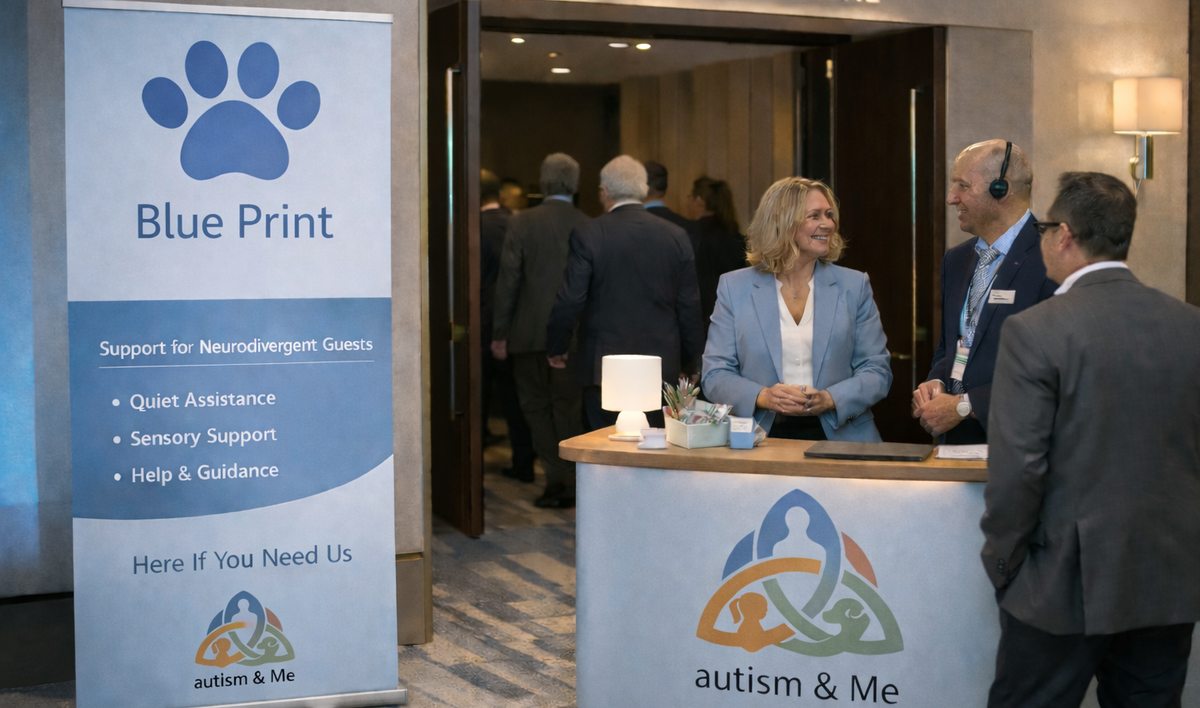
We deliver neurodiversity-affirming training, consultancy and practical tools that support Ireland’s Autism Innovation Strategy, across home, school, workplace and community settings.
Neurodiversity-affirming training for schools, public services and organisations.
We look at your setting with you and agree what to change, starting with the people in it.
Resources you can use straight away, including iLEARN, our tailored learning approach.
Our focus is practical. We do not stay in theory. We focus on what can be applied in real situations.
Across Ireland, systems are often overstretched. Supports are not always designed for the level of need now present, leaving individuals and families navigating environments that do not fully support them.
Autism & Me responds with structured, evidence-informed approaches that:
iLEARN MY WAY starts from the same place as everything we do: the person as they are, here and now. We meet, we listen, we review and we tailor.
It is not only for school. It applies in every sector, because we all learn and respond to the environments we find ourselves in.
Small changes can make profound differences to a person with autism, if, and only if, they are heard.
You don’t need to change everything at once. We help you listen, then act, one small step at a time.
Hear from the person, in the way they communicate, and from the family and carers who know them.
Look at the setting as it is today: what works, what is hard and what the person notices.
Choose one small, realistic change together, with the person’s say at the centre.
Put it in place, then ask the person how it is going, not just the adults around them.
Keep what helps, adjust what doesn’t, and choose the next small change.
We go at the person’s pace, not the system’s.
Tell us where you are now, at home, in school, at work or in your service, and we will help you find the first step.
Thank you for visiting autismandme.ie. Let us know where you’re connecting from.