(1).png)


The person
The expert on their own experience. We listen to how they communicate, whether that is speech, writing, AAC, gesture or another way of showing what helps and what doesn’t.
Whether you are a parent looking for answers, trying to understand what support will actually help, or simply feeling overwhelmed by how much there is to carry, Autism & Me is here to make things clearer. We take strong research and turn it into practical ideas you can use in real life at home, in school, and in everyday situations. That means looking at what is making life harder, what is increasing anxiety, and what changes could make things calmer, clearer, and more manageable for your child and your family. Our approach brings together evidence, universal design, and lived experience, so the support we offer is not only informed, but realistic. The aim is not to hand you more information and leave you to work it out alone. The aim is to help you understand what matters, what can change, and what next steps are worth taking. Because inclusion should not be an extra. It should be part of how things are designed from the start.

It provides Irish educators and policymakers with a credible, evidence-based foundation that aligns with UDL, neuro-affirming practice, and trauma-informed approaches. These rigorously researched approaches are proven to assist neurodivergent learners and adults in developing skills and thriving. We help clients understand these practices thoroughly and implement them consistently within their settings.
Our philosophy extends beyond accommodation or correction. We view neurodiversity as a natural human variation, celebrating neurodivergent strengths and perspectives. Our focus is on removing barriers and creating environments where neurodivergent individuals can flourish authentically.
Autism & Me works within and across the community to build greater understanding of what family life can look like when autism is part of it. That means working not only with families, but also with employers, professionals, school leaders, teachers, sporting organisations, unions, politicians, and policy makers. We want to raise awareness of the pressures that often go unseen, particularly for parents who are carrying the demands of work alongside the realities of supporting an autistic child and wider family life. In those circumstances, flexibility is not a luxury. It is often what allows an excellent employee to remain in employment, continue contributing at a high level, and sustain family life without reaching breaking point. A better understanding of these pressures can lead to better accommodations and more realistic entitlements for parents who are trying to remain in employment while also attending to the needs of their child. It is time that families like mine, and not only families with autism, are properly heard. Too often, the practical realities they carry remain unseen until they reach crisis point. Our work is about helping the wider systems around families respond in ways that are more informed, more flexible, and better matched to the realities they are carrying.


I have always been cautious about the way labels are used, not because diagnosis lacks value, but because it can too easily become a substitute for understanding. A diagnosis may describe part of a person’s neurological profile, but it does not define the person. My daughter is not her diagnosis. She is an individual with her own character, strengths, needs, preferences, and way of experiencing the world. For that reason, I believe our focus must move beyond labels alone and return to the person in context. Labels can help open access to support, but they should never narrow how someone is seen or reduce expectations of who they are. The more important question is not simply what category a person fits into, but what they need in order to participate, communicate, learn, and live with dignity. This also requires a wider social and institutional shift. Neurodivergent individuals are too often expected to adapt to environments that make little effort to adapt in return. Where a physical difference is visible, accommodation is more readily understood as necessary. Where the difference is neurological, supports such as visual communication, augmentative and alternative communication, sensory regulation strategies, predictability, or environmental adjustments are still too often treated as optional or exceptional. That distinction is neither fair nor sustainable. My position is that these supports should be understood as part of good design and good practice. They are not indulgences. They are not special treatment. They are practical means of making participation possible. A more just and intelligent society would recognise this without hesitation and would build such responses into everyday systems as standard.
No child or adult should ever feel excluded in a society that claims to value inclusion. Inclusion is not something to celebrate as an achievement; it is a basic human right protected by legislation. Instead of promoting inclusion as a concept, we need to implement universal design principles that make inclusion real and accessible for everyone. My vision is a society where neurodivergent individuals are met with understanding, adaptation, and respect. A society where inclusion is lived, not advertised. Thank you for taking the time to learn more about Autism and Me. We are committed to creating meaningful, practical change that is grounded in lived experience and compassion. If you believe Autism and Me can support you, your organisation, or someone you care about, please get in touch. Together, we can build a world where every individual has the support they need to thrive.
Autistic people, and the families and carers who know them best, are the experts. Everything we do begins by listening to them.
Not where you want them to be. Where they are, in the here and now.
That is where every plan should begin.We see the value of listening to the person with autism and to their family and carers. Professional knowledge matters, but it works best when it supports their voice and their choices.
The expert on their own experience. We listen to how they communicate, whether that is speech, writing, AAC, gesture or another way of showing what helps and what doesn’t.
They know the person across years, places and moods. Their knowledge fills in what a single meeting never could.
Training and evidence bring real value when they serve the person, not when they replace what the person and family tell us.
“Here is where you should be. Let’s get you there.”
“Tell us where you are today. We’ll start from there.”
Autism & Me is a team of professionals from across Ireland who work in education, industry, health, finance, community services and public-sector roles. Many of us are neurodivergent, and many are parents, carers and long-standing advocates.
What connects us is a shared commitment to building an Ireland where autistic people can access school, work, services and community life with dignity, clarity and ease.
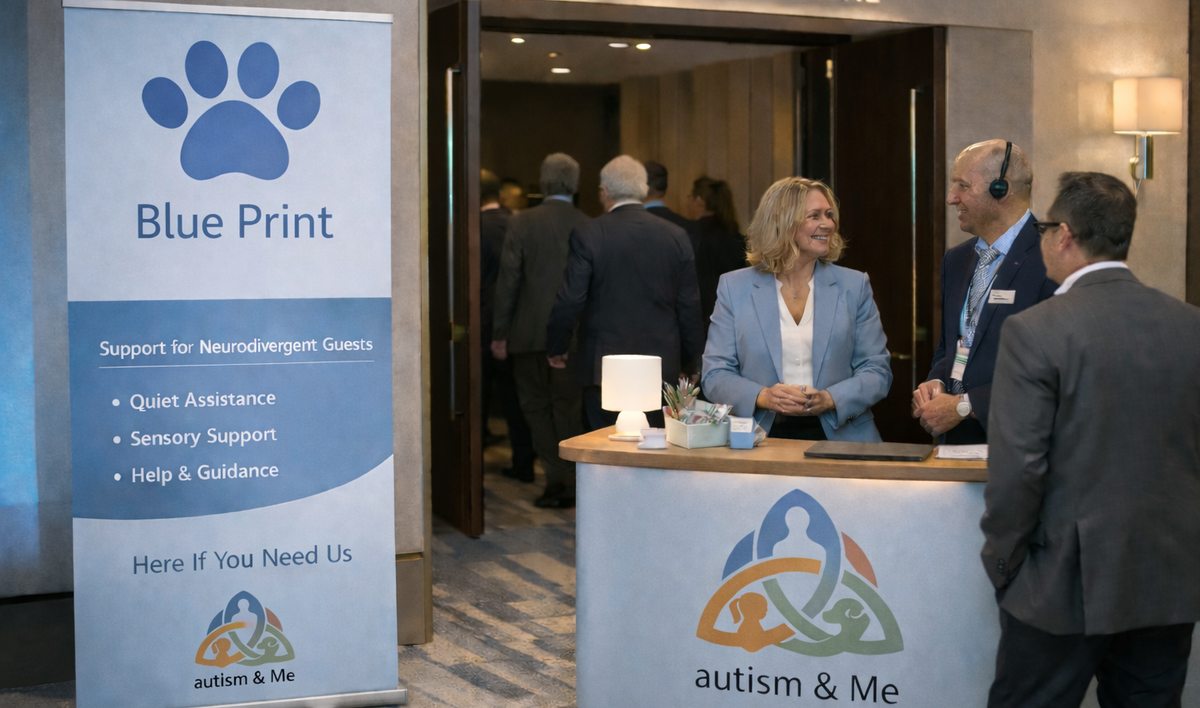
We deliver neurodiversity-affirming training, consultancy and practical tools that support Ireland’s Autism Innovation Strategy, across home, school, workplace and community settings.
Neurodiversity-affirming training for schools, public services and organisations.
We look at your setting with you and agree what to change, starting with the people in it.
Resources you can use straight away, including iLEARN, our tailored learning approach.
Our focus is practical. We do not stay in theory. We focus on what can be applied in real situations.
Across Ireland, systems are often overstretched. Supports are not always designed for the level of need now present, leaving individuals and families navigating environments that do not fully support them.
Autism & Me responds with structured, evidence-informed approaches that:
iLEARN MY WAY starts from the same place as everything we do: the person as they are, here and now. We meet, we listen, we review and we tailor.
It is not only for school. It applies in every sector, because we all learn and respond to the environments we find ourselves in.
Small changes can make profound differences to a person with autism, if, and only if, they are heard.
You don’t need to change everything at once. We help you listen, then act, one small step at a time.
Hear from the person, in the way they communicate, and from the family and carers who know them.
Look at the setting as it is today: what works, what is hard and what the person notices.
Choose one small, realistic change together, with the person’s say at the centre.
Put it in place, then ask the person how it is going, not just the adults around them.
Keep what helps, adjust what doesn’t, and choose the next small change.
We go at the person’s pace, not the system’s.
Tell us where you are now, at home, in school, at work or in your service, and we will help you find the first step.
Thank you for visiting autismandme.ie. Let us know where you’re connecting from.